Permian Basin Again Largest Prouction in the Nation as in Wwii
| Permian Basin | |
|---|---|
| | |
 The West Texas Permian Bowl | |
| Coordinates | 32°30′Northward 103°00′Westward / 32.500°N 103.000°W / 32.500; -103.000 |
| Etymology | Permian |
| Location | Southwestern N America |
| Country |  Us Us |
| State(s) | Texas & New United mexican states |
| Cities | Midland, Odessa |
| Characteristics | |
| On/Offshore | Onshore |
| Boundaries | Matador Arch (Due north) Ouachita–Marathon thrust belt (Due south) |
| Expanse | >86,000 sq mi (220,000 kmtwo) |
| Hydrology | |
| River(s) | Pecos River |
| Geology | |
| Basin type | Cratonic basin (Bally & Snelson) Interior sag basin (Kingston et al.) Intracontinental complex basin (Klemme) |
| Orogeny | Hercynian |
| Age | Pennsylvanian-Guadalupian |
| Stratigraphy | Stratigraphy |
| Field(s) | Fields |


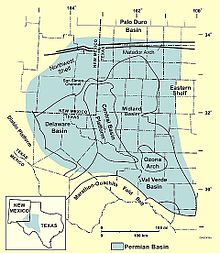
The Permian Basin is a big sedimentary basin in the southwestern function of the United States. The basin contains the Mid-Continent Oil Field province. This sedimentary basin is located in western Texas and southeastern New Mexico. It reaches from simply south of Lubbock, past Midland and Odessa, s nearly to the Rio Grande River in southern West Central Texas, and extending west into the southeastern part of New Mexico. It is so named because it has i of the world's thickest deposits of rocks from the Permian geologic period. The greater Permian Basin comprises several component basins; of these, the Midland Bowl is the largest, Delaware Basin is the second largest, and Marfa Basin is the smallest. The Permian Basin covers more than than 86,000 square miles (220,000 km2),[1] and extends across an expanse approximately 250 miles (400 km) wide and 300 miles (480 km) long.[2]
The Permian Basin lends its name to a large oil and natural gas producing area, part of the Mid-Continent Oil Producing Expanse. Total production for that region up to the beginning of 1993 was over 14.9 billion barrels (2.37×10⁹ kthree). The Texas cities of Midland, Odessa and San Angelo serve as the headquarters for oil production activities in the bowl.
The Permian Bowl is also a major source of potassium salts (potash), which are mined from bedded deposits of sylvite and langbeinite in the Salado Formation of Permian age. Sylvite was discovered in drill cores in 1925, and production began in 1931. The mines are located in Lea and Eddy counties, New Mexico, and are operated by the room and pillar method. Halite (rock salt) is produced as a byproduct of potash mining.[three] [4] [5] [six]
Components [edit]
Delaware Basin [edit]

The Delaware Bowl is the larger of the two major lobes of the Permian Basin within the foreland of the Ouachita–Marathon thrust belt separated past the Central Bowl Platform. The basin contains sediment dating to Pennsylvanian, Wolfcampian (Neal Ranch and Lenox Hills Formations[vii]), Leonardian (Avalon Shale), and early Guadalupian times. The due east-dipping Delaware basin is subdivided into several formations (Figuretwo) and contains approximately 25,000 feet (7,600 m) of laminated siltstone and sandstone. Aside from clastic sediment, the Delaware basin also contains carbonate deposits of the Delaware Mountain Group, originating from the Guadalupian times when the Hovey Channel allowed access from the bounding main into the bowl.[5]
Midland Bowl [edit]
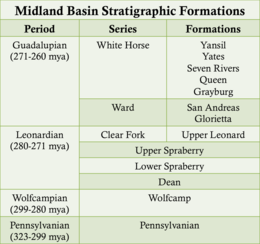
The westward-dipping Midland Basin is subdivided into several formations (Figure four) and is equanimous of laminated siltstone and sandstone. The Midland Bowl was filled via a large subaqueous delta that deposited clastic sediment into the basin. Aside from clastic sediment, the Midland Basin too contains carbonate deposits originating from the Guadalupian times when the Hovey Channel immune access from the ocean into the basin.[5]
Central Bowl Platform [edit]

The Central Basin Platform (CBP) is a tectonically uplifted basement block capped past a carbonate platform. The CBP separates the Delaware and Midland Basins and is subdivided into several formations, from oldest to youngest Neal Ranch, Lennox Hills, Abo, Yeso, Glorieta, San Andres, Grayburg, Queen, Seven Rivers, Yates, and Tansill Formations (Figurefive). The sequence mainly comprises carbonate reef deposits and shallow marine clastic sediments.[5]
Eastern and Northwest Shelves [edit]
The Eastern and Northwestern Shelves are equanimous of shelf border reefs and shelf carbonates flanking the Delaware and Midland Basins that grade up-dip into siltstones and evaporites. The Eastern and Northwestern Shelves are subdivided into the San Andres, Grayburg, Queen, Seven Rivers, Yates, and Tansill Formations.[5]
San Simon Channel [edit]
The San Simon Aqueduct is a narrow syncline that separated the Fundamental Basin Platform from the Northwestern Shelf during Leonardian and Guadalupian times.[v]
Sheffield Channel [edit]
The Sheffield Channel separates the southern margin of the Midland Bowl from the southern shelf and the Ouachita–Marathon thrust-belt during Leonardian and Guadalupian times.[5]
Hovey Aqueduct [edit]
The Hovey Channel is a topographical low located on the southern edge of the Delaware Basin, allowing access to the Panthalassa body of water during Guadalupian times.[v] The Hovey Channel was originally an anticline which formed during Precambrian faulting,[8] and was the main source of sea water for the Delaware Basin. The closing of the Hovey Channel towards the end of the Permian Flow eventually caused the death of the Permian Reef, every bit without water existence brought in through the Channel, salinity levels rose drastically in the Delaware Basin and the reef could not survive.[9]
Horseshoe Atoll [edit]
The Horseshoe Atoll is a due west-tilting arcuate chain of reef mounds 175 miles (282 km) long located in the Midland Basin, consisting of ane,804 feet (550 thou) of limestone accumulated in the Pennsylvanian and 1,099 feet (335 m) in the Permian, with 15 pregnant petroleum reservoirs from 6,099 feet (ane,859 m) to 9,902 feet (3,018 m) in depth.[xi] The reef complex consists of Upper Pennsylvanian Strawn, Coulee and Cisco limestones, overlain by Lower Permian Wolfcamp sandstones and shales of terrigenous origin prograding northeast to southwest.[12] The first product well, Seabird Oil Company of Delaware No.ane-B J.C. Caldwell, was completed in 1948.[13]
Depositional history [edit]
The Permian Basin is the thickest deposit of Permian aged rocks on Globe which were quickly deposited during the collision of North America and Gondwana (Due south America and Africa) betwixt the belatedly Mississippian through the Permian. The Permian Basin also includes formations that date back to the Ordovician Period, 445 million years ago (mya).
Proterozoic [edit]
Prior to the breakdown of the Precambrian supercontinent and the formation of the modernistic Permian Bowl geometry, shallow marine sedimentation onto the bequeathed Tobosa Basin characterized the passive margin, shallow marine surroundings. The Tobosa Basin also contains basement rock that dates dorsum to 1330 million years agone (mya), and that is still visible in the present-twenty-four hour period Guadalupe Mountains. The basement rock contains biotite-quartz granite, discovered at a depth of 12,621 feet (3,847 m).[8] In the nearby Apache and Glass Mountains, the basement rock is fabricated of metamorphosed sandstone and Precambrian-aged granite. The entire area is also underlain by layered mafic rocks, which are thought to exist a office of Pecos Mafic Igneous Suite,[14] and extends 220 miles (360 km) into the southern The states. Information technology has been dated to 1163 mya.
Early to Mid Paleozoic (Belatedly Cambrian to Mississippian) [edit]

Permian Basin stratigraphic column
Ordovician Flow (485.iv–443.viii mya) [edit]
Each period from the Paleozoic Era has contributed a specific lithology to the Tobosa Basin, accumulating into almost 6,600 feet (2,000 m) of sediment at the starting time of the Pennsylvanian Period (323.ii–298.9 mya).[viii] The Montoya Group is the youngest rock formation in the Tobosa Basin and was formed in the Ordovician Period (485.4–443.eight mya), and sit down directly on the igneous and metamorphic basement rocks. The rocks from the Montoya Grouping are described as light to medium gray, fine to medium grained crystalline calcareous dolomite. These rocks were sometimes inter-bedded with shale, dark grey limestone, and, less normally, chert. the Montoya Group sequence is made upwardly of carbonate limestone and dolomite which is described as dense, impermeable, and non-porous, and is more commonly found in the Drinking glass Mountains outcrop, with thickness varying from 151 to 509 feet (46 to 155 1000).[eight]
Silurian Catamenia (443.viii–419.2 mya) [edit]
During the Silurian Period, the Tobosa Bowl experienced dramatic changes in sea level which led to the formation of multiple rock groups. The first of these groups, called the Fusselman Germination, is by and large made upward of lite grayness, medium to coarse grained dolomite. The thickness of this formation varies from 49 to 164 feet (fifteen to fifty one thousand), and parts of the Fusselman Formation were also subject field to karstification, which indicates a drop in sea level. The 2d rock grouping that formed during the Silurian Period is called the Wristen Formation, which is mud, shale, and dolomite rich rock that reaches a thickness of i,480 feet (450 one thousand) in some places. Karstification of the Fusselman Formation shows that a drib in sea level occurred, but sea levels rose again during a transgressive event, which atomic number 82 to the creation of the Wristen Formation. Body of water levels would and then drop over again, which led to major exposure, erosion, and karstification of these formations.[eight]
Devonian Flow (419.ii–358.nine mya) [edit]
The Thirtyone Germination was developed during the Devonian Catamenia. This formation is characterized by its limestone, chert, and shale beds, some of which had a summit thickness of 980 anxiety (300 k). this germination had many different types of limestone, including light-colored siliceous, chert-dominated, crinoid-rich, and sandy limestone. The Thirtyone Formation is very similar to the formation of the Mississippian Period, which is probable because in that location was lilliputian to no change in the surround during this time.[8]
Mississippian Period (358.9–323.2 mya) [edit]
The Mississippian Limestone is the master formation to develop during this Menses. This formation, like to the previously mentioned Thirtyone Formation, is equanimous primarily of limestone and shale. The limestone beds are described every bit being "dark-brown to dark dark-brown, micro-crystalline to very finely crystalline, normally sandy, and dolomitic", while the shale beds are "grayness to black, difficult, platy, pyritic, organic, and very siliceous".[8] The Mississippian Limestone ranges from between 49 to 171 anxiety (15 to 52 m) in thickness, while more often than not being thinner towards the southern role of the Tobosa Basin.
The Barnett Shale is the second formation to have developed during the Mississippian Period. Information technology consists mainly of silty brown shale and fine-grained sandstone and siltstone. This Formation was much thicker than the Mississippian Limestone, ranging from 200 to 460 feet (threescore to 140 m). The increased thickness can exist explained by increased sedimentation in the surface area, which was likely acquired by tectonic action in the region.[8]
Tectonic Activity During the Mississippian Flow [edit]
The Ouachita Orogeny occurred during the Belatedly Mississippian, leading to tectonic activity in the region. The subsequent folding and faulting acquired by this Orogeny led to the Tobosa Basin being divided into iii sections: the Delaware Basin, the Midland Basin, and the Central Bowl Platform. The end of the Mississippian Menstruation also led to the beginning of the formation of the modernistic Permian Reef Complex. The legacy of the early to mid Paleozoic is most half-dozen,600 anxiety (2,000 m) of sediments that were accumulated due to almost uninterrupted sedimentation.[eight]
Late Paleozoic (Pennsylvanian to Permian) [edit]
Pennsylvanian Menstruum (323.2–298.9 mya) [edit]
The Pennsylvanian Period marked the beginning of geological processes that would shape the Permian Basin into what we run across today. Rifting events during the Cambrian Catamenia (early Paleozoic) left fault zones in the region. This fault zones acted every bit planes of weakness for faulting that was later initiated by the Ouachita Orogeny. These error zones acquired the Tobosa Basin to be transformed, due to tectonic activity, into the Permian Reef Circuitous, which comprises three parts: the Central Basin Platform, which is encircled by faults, and the Midland and Delaware Basins on either side. Mississippian sediments are absent either due to erosion or nondeposition. Marine shales were deposited in the centre of the Delaware, Midland and Val Verde basins, while the basins' periphery saw the degradation of shallow marine, carbonate shelf and limestone sediments.[fifteen] : 6, 17–18 [16] [17]
The Morrow Germination [edit]
The Early on Pennsylvanian Morrow Formation underlies the Atoka Formation. The Morrow is an important reservoir consisting of clastic sediments, sandstones and shales, deposited in a deltaic environs.[15] : x, 37 [16] : 258, 266 [17] : 106–107
Other formations [edit]
The Pennsylvanian Period also led to the development of other geologic formations, although none had the importance of the Morrow Formation. The Atoka Formation lies conformably on top of the Morrow Germination, and is characterized past its fossil-rich limestone inter-bedded with shale, reaching a max thickness of 660 anxiety (200 m). During the formation of the Atoka, uplift was withal occurring in the region, leading to increased sedimentation as the surrounding highlands were eroded. The increased sedimentation led to the formation of medium- to coarse-grained sandstone. In the Atoka Formation, the starting time reef structures that formed in the Delaware Basin are visible.[8]
The Strawn Formation formed after the Atoka, also during the Pennsylvanian Period, and reached a max thickness of 660 feet (200 m). In this formation, in that location was a significant increase in reef mounds. The Strawn Formation is primarily made upwards of massive limestone, forth with "fine to medium-grained sandstone, night to light-greyness shale, and occasional cherry-brown, greenish-grayness, bituminous shale".[8] A great number of different fossil types were preserved in this germination, including brachiopods, foraminifera, bryozoans, corals, and crinoids.
The Pennsylvanian Period also includes two other formations, the Canyon and Cisco Formations, which are significant due to the major oil reservoirs discovered in them.[15]
Permian Period (298.9–251 mya) [edit]
The Permian Catamenia was a fourth dimension of major reef building to transform the Permian Reef Complex into a major reef arrangement, with Permian-aged stone formations making up 95% of the present-day outcrops in the Permian Bowl. When considering any type of reef building that occurred in the Permian, it is important to keep in listen that tectonics played a major office. During this menstruation, the supercontinent of Pangaea, which lasted from 335 to 175 mya, started undergoing breakup. Pangea was clustered together near the equator and surrounded by the superocean Panthalassa, with the Permian Basin located on its western border inside v-10 degrees of the equator.[18] Any reef edifice surround would need a source of water, and the Delaware Basin was located near a marginal sea. Thank you to the Hovey Channel, this bounding main transported water into the Delaware Basin. Global temperatures during this time were warm, as the world climate was changing from icehouse to greenhouse. This rise in global temperatures besides led to the melting of water ice masses located towards the South Pole, which then led to a rise in sea levels.[9]
The Permian Menstruation has been separate up into primary Epochs, each of which has divide subdivision. In each sub epoch, a different formation was formed in the different parts of the Permian Reef Complex.[nineteen]
Cisuralian Epoch (298.ix–272.3 mya) [edit]

Climatic zones of the Carboniferous-Permian boundary
The Cisuralian Epoch contained 2 ages, the Wolfcampian and the Leonardian, both of which have a geological formation in the Permian Basin named after them.
The Wolfcampian Formation lies conformably on top of the Pennsylvanian Formation and is the offset formation from the Permian Menstruum. Its limerick varies depending on its location in the Bowl, with the northernmost office being more rich in shale. The thickness of this formation too varies, reaching a maximum of ane,600 feet (500 m). The Wolfcampian is made upward primarily of gray to brown shale and fine-grained, chert-dominated, brown limestone. In that location are also interbedded layers of fine-grained sandstone constitute within the formation.[19]
The primary formation that remains from the Leonardian Age is called the Bone Jump Limestone, which reaches a max thickness of two,000 feet (600 m) and lies directly below the Capitan Reef Complex. The Bone Spring limestone can be divided into two formations: the Victorio Peak Member, which consists of massive beds of limestone measuring upwards to 98 feet (30 m); and the Cutoff Shale Member, which is formed from black, platy, siliceous shale and shaley sandstone.[20] The Bone Spring Limestone consists of several fossils, such as bryozoans, crinoids, and spirifers, but lack algae and sponges that are plentiful in the residue of the Permian Reef Circuitous. Rocks from the Bone Jump Limestone are predominantly found in the Delaware Bowl, but the Victorio Tiptop Member extends into the shelf margin area.[21]
Guadelupian Epoch (272.iii–259.viii mya) [edit]
The Guadalupian Epoch was named subsequently the Guadalupe Mountains, since this epoch in the Permian is when reef building was at its near efficient. Lasting from approximately 272–260 mya, this epoch was dominated by the Delaware Mount Group, which can be further subdivided into stone divisions based on location in the Permian Reef Complex.[21]
Brushy Canyon Formation [edit]
The first formation that makes upwards the Delaware Mountain Group is the Brushy Canyon Formation, and it lies in the Delaware Bowl. The Brushy Canyon Formation is made up of thin interbedded layers of alternating fine grained and massive quartz sandstone, besides as shaley brown to black sandstone. This formation reaches a maximum thickness of 1,150 feet (350 1000) but thins out significantly as information technology approaches the bowl margins due to transgressive onlap.[21] The Brushy Canyon Germination as well contains small reef patches, ripple marks, and crossed bedded strata, that indicate that the Delaware Bowl had a shallow water surroundings at this time.
Cherry Canyon Formation [edit]
The adjacent unit of measurement of the Delaware Mountain Group is the Carmine Coulee, which had multiple unlike sub-units and extended into the Delaware Basin and the surrounding shelf environments. The Crimson Canyon Formation can be subdivided into four sub-units, each of which volition be discussed briefly.
Lower Gateway Formation [edit]
The Lower Getaway fellow member is a limestone that has different characteristics based on its location in the Delaware Basin, and contains patch reefs close to the basin margin. These reefs are often constitute on limestone conglomerate and breccias. The Upper Getaway Fellow member is more consistent and is characterised equally a thick bedded dolomite which integrates into the San Andres Germination as information technology moves toward the shelf.[21] The heart unit of the Blood-red Coulee Formation is the South Wells Member, which is composed of sandstone and integrates itself into the Goat Seep Reef every bit it moves towards the basin shelf.
Manzanita Member [edit]
The upper unit is the Manzanita Member, which consists of dolomite, and gets pinched out underneath the Capitan Formation as information technology moves into the basin margins. All four members of the Cherry Canyon Formation have undergone dolomitization near the bowl margins. This is axiomatic since the calcite/aragonite bioclastic debris that existed as a office of this formation has been preserved as molds in dolomite.[21] It has been suggested by some authors that the clasts and debris might have been dolomitic upon degradation, but that is improbable since the debris came from the reef, which was not dolomitic.[21]
Bell Coulee Formation [edit]
The Bell Coulee Formation is the next unit of measurement in the Delaware Mountain Group, and information technology is the historic period equivalent unit to the Capitan Reef Formation which formed on the shelf. The Bell Coulee Germination consists of "united nations-fossiliferous, dark-gray to black, platy, fine-grained limestone".[21] All the Ruddy Canyon Formation and the lesser function of the Bell Canyon Formation have thin interbeds of nighttime-colored bioclastic limestone and fine-grained sandstone. As these formations move towards the bowl margins, the sandstone wedges out and the limestone thickens into massive, meters thick beds, containing reef talus.[21]
Goat Seep Reef Formation [edit]
The Caprine animal Seep Reef Germination lies on the shelf margin and integrates with the Getaway Germination in the bowl and the San Andres Formation towards the Shelf. This formation is described every bit 1,150 feet (350 g) thick, one mile (i,600 g) long, and fabricated upward entirely of massive dolomite. In the bottom half of the formation, the dolomite is stratified into massive beds.[21] This formation as well contains molds of organisms destroyed by the dolomitization procedure.
Reef edifice in the Guadalupian Epoch [edit]
The Guadalupian Epoch is one of the nigh successful in history in terms of reef edifice, since most Permian reefs reached their maximum in size, variety, extent, and abundance during this Epoch, with the Capitan Reef being i of the most famous examples. In the Guadalupian, reefs were abundant globally, and grew in places such equally the Delaware Bowl, the Zechstein Basin in Eastern Europe, along the Tethys Ocean, and in cool water shelves in the Panthalassa Body of water. The stop of this golden historic period for reef edifice occurred due to the "cease-Guadalupian reef crisis", which involved global drops in sea levels and regional salinity fluctuations. The movement and standoff of micro-continents during the break up of Pangea also caused the destruction of many Guadalupian Reefs.[9] Fifty-fifty with the number of reefs from that epoch that have been destroyed, in that location are over 100 Guadalupian reefs that remain in the world, the most from whatever Permian epoch.
Reef growth during the Tardily Permian [edit]
The growth of the Capitan Reef, which is referred to every bit a "massive member" due to it being formed from massive limestone, tin exist described in three stages. The commencement stage is the establishment of the reef and its rapid growth. Due to the slower rates of subsidence of this time, the reef was able to build itself upwardly chop-chop. One time the reef reached sea level, it began to grow horizontally, since it could non grow vertically anymore. The reef environs during the first stage of evolution was described as warm (around 68 °F (20 °C)), shallow, high energy, clear water that was free from debris and which had a normal salinity level of 27 to 40 ppt (parts per g).[22] The basin h2o provided plenty of nutrients, since there was continuous upwelling of water that mixed newly brought marine h2o with anoxic water from the basin floor. The makeup of the reef is described as being built primarily from erect sponges, which have big, rigid skeletons, and abundant red algae, microbial micrite, and inorganic cement.[23] The microbial micrite worked to trap sediment.
One of the most prominent sponges that made upwards the Capitan Reef was the sponge family Guadalupiidae, a sponge that get-go appeared on Glass Mountains in the mid Permian and had spread into the Delaware Basin by the tardily Permian.
At that place were more environmental changes to mark the second stage of the formation of the Capitan Reef. This period of growth was marked by eustatic changes in global sea levels, due to frequent glaciations. The reef experienced major growth vertically at this stage and grew at a rapid enough pace to keep upwardly with ascension bounding main levels. The Capitan Reef likewise constitute a stable foundation on the reef debris and talus that rested on its slopes, and this foundation allowed the reef to grow outward. In some locations, nutrients and minerals were then abundant that the Capitan Reef grew out almost 50 km from the starting point.[24]
Reef expiry during the Late Permian [edit]
The tertiary stage of the Capitan Reef is the death of the reef organisation. Ocean currents in the Permian played a huge part in setting up the climate of the region and for aiding in the growth and decease of the Capitan Reef. The climate of the basin region was hot and arid, which is shown in the evaporite deposits that tin can exist found in the back reef region.
The end in growth and accumulation of the Permian Reef Complex was influenced by tectonics. During the terminate of the Permian Period, the supercontinent of Pangaea was beginning its break upward, which drastically changed the conditions that were previously favourable for reef growth. Alter in tectonics express the commutation of body of water water in the Hovey Channel, which then led to a salinity increment in the Permian Basin. The reef could not survive this drastic change in h2o salinity, and was therefore destroyed.[9]
Up until the Guadalupian, the Permian Basin had adequate water circulation with fresh water coming in from the Hovey Channel. Evaporite growth along the bottom portions of the basin showed that the h2o column was most likely stratified and euxinic, pregnant the h2o was both anoxic and sulfidic. The passageways between the Delaware and Midland Basins were restricted due to tectonic changes, and this caused the salinity of the water to rise.[25] The growing temperatures in the late Permian combined with the increase in salinity caused the extinction of the Capitan Reef, besides as the formation of evaporites with the basin.
The layers of evaporites that formed as a issue of increased salinity is called the Castile Formation. This formation consists of alternating layers of gypsum/anhydrite and limestone, equally well as massive beds of gypsum/anhydrite, salt, and some limestone.[26] The unit measures about four,300 anxiety (one,300 1000) in total and was formed during the Lopingian Epoch. The individual layers (laminae) of gypsum/anhydrite are between 0.039 inches (1 mm) and 3.9 inches (ten cm) in thickness, which is thought to correlate with the bowl salinity on a year by yr footing.
The Capitan Reef had been altered diagenetically early on in its history, specially after the deposition of the Castile Formation. At that place is evidence of fabric amending throughout this germination, which is thought to betoken the dehydration and rehydration process of the gypsum and anhydrites. At that place is too evidence of evaporite calcitization. The reef system was buried until it was exposed in the Mesozoic Era as a result of tectonic action by the Laramide Orogeny.[25] The deep water shale and carbonate reefs of the Delaware and Midland Basins and the Key Basin Platform would become lucrative hydrocarbon reservoirs.[5] [27]
Generalized facies tracts of the Permian Bowl [edit]
The Permian bowl is divided into generalized facies belts differentiated by the depositional environs in which they formed, influenced by sea level, climate, salinity, and admission to the sea.
Lowstand systems tract [edit]
Lowering sea level exposes the peritidal and potentially, the shelf margin regions, allowing linear channel sandstones to cut into the shelf, extending beyond the shelf margin atop the gradient carbonates, fanning outward toward the basin. The tidal flats during a lowstand contain aeolian sandstones and siltstones atop supratidal lithofacies of the transgressive systems tract. The basin fill during a lowstand is equanimous of thin carbonate beds intermingled with sandstone and siltstone at the shelf and sandstone beds inside the basin.
Transgressive systems tract [edit]
These facies results from the abrupt deepening of the basin and the reestablishment of carbonate production. Carbonates such as bioturbated wackstone and oxygen poor lime mud accumulate atop the underlying lowstand systems tract sandstones in the basin and on the gradient. The tidal flats are characterized by supratidal faces of hot and arid climate such every bit dolomudstones and dolopackstones. The bowl is characterized by thick carbonate beds on or shut to the shelf with the shelf margin condign progressively steeper and the basin sandstones becoming thinner.
Highstand systems tract [edit]
Highstand systems tract facies results from the slowing down in the rise of sea level. It is characterized by carbonate production on the shelf margin and dominant carbonate deposition throughout the basin. The lithofacies is of thick beds of carbonates on the shelf and shelf margin and sparse sandstone beds on the slope. The basin becomes restricted by the formation of blood-red beds on the shelf, creating evaporites in the basin.[27] [28] [29]
Tectonic history [edit]
During the Cambrian–Mississippian, the ancestral Permian Basin was the broad marine passive margin Tobosa Bowl containing deposits of carbonates and clastics. In the early on Pennsylvanian–early Permian the collision of Due north American and Gondwana Country (South America and Africa) caused the Hercynian orogeny. The Hercynian Orogeny resulted in the Tobosa basin existence differentiated into 2 deep basins (the Delaware and the Midland Basins) surrounded by shallow shelves. During the Permian, the bowl became structurally stable and filled with clastics in the basin and carbonates on the shelves.[30]
Lower Paleozoic passive margin stage (late Precambrian–Mississippian, 850–310 Mya) [edit]
This passive margin succession is present throughout the southwestern US and is upwardly to 0.93 miles (1.50 km) thick. The ancestral Permian basin is characterized by weak crustal extension and low subsidence in which the Tobosa basin developed. The Tobosa basin contained shelf carbonates and shales.[31]
Collision phase (late Mississippian–Pennsylvanian, 310–265 Mya) [edit]
The ii lobed geometry of the Permian basin separated by a platform was the result of the Hercynian collisional orogeny during the standoff of Northward America and Gondwana Country (South America and Africa). This collision uplifted the Ouachita-Marathon fold belt and deformed the Tobosa Basin. The Delaware Basin resulted from tilting along areas of Proterozoic weakness in Tobosa basin. Southwestern pinch reactivated steeply dipping thrust faults and uplifted the Central Basin ridge. Folding of the basement terrane split the basin into the Delaware basin to the west and the Midland Bowl to the due east.[30] [32]
Permian Basin phase (Permian, 265–230 Mya) [edit]
Rapid sedimentation of clastics, carbonate platforms and shelves, and evaporites proceeded synorogenically. Bursts of orogenic activity are divided past three athwart unconformities in basin strata. Evaporite deposits in the small remnant basin mark the final stage of sedimentation as the basin became restricted from the bounding main during sea level fall.[31] [33]
Hydrocarbon product and reserves [edit]

The Permian Basin is the largest petroleum-producing bowl in the United States and has produced a cumulative 28.9billion barrels of oil and 75trillion cubic feet of gas. Currently in early on 2020, over 4 1000000 barrels of oil a day are being pumped from the basin. Eighty percentage of estimated reserves are located at less than 10,000 anxiety (three,000 m) depth. Ten pct of the oil recovered from the Permian Basin has come up from Pennsylvanian carbonates. The largest reservoirs are within the Central Basin Platform, the Northwestern and Eastern shelves, and within Delaware Basin sandstones. The Main lithologies of the major hydrocarbon reservoirs are limestone, dolomite, and sandstone due to their loftier porosities. However, advances in hydrocarbon recovery such every bit horizontal drilling and hydraulic fracturing have expanded production into unconventional, tight oil shales such as those constitute in the Wolfcamp Shale.[6] [34]
History of resource [edit]

Santa Rita No. 1 rig, used in the discovery of the Big Lake Oil Field in 1923.
In 1917, J.A. Udden, a University of Texas geology professor, speculated that the Marathon Fold, associated with the Marathon Mountains, may extend north. This fold theory was further elaborated on in 1918 by geologists R.A. Liddle and J.W. Beede. The potential construction was thought to be a potential trap for oil. Based on this Marathon Fold theory, and known oil seeps, examination drilling commenced in the eastern Permian Bowl.[35]
Oil reserves in the Permian Basin were first documented by W.H Abrams in Mitchell County, West Texas in 1920. The first commercial well was opened a yr subsequently in 1921, in the newly discovered Westbrook Oil Field in Mitchell Canton, at a depth of 2,498 feet (761 thousand). Initially, the Permian Basin was thought to have a bowl-similar shape, with geological survey crews unable to study the inside of the bowl due to a lack of outcrops. The adjacent few years contained discoveries of multiple oil fields, such every bit the Big Lake oil field (1923), the World oil field (1925), the McCamey oil field (1925), the Hendrick oil field (1926), and the Yates Oil Field (1926). All of these discoveries were fabricated past random drilling or surfacing mapping. Geophysical tests were vital in mapping the region, since tools such as seismographs and magnetometers were used to find anomalies in the area.[36] [35]
By 1924, companies establishing regional geological offices in the basin included the California Company (Standard Oil of California), Gulf Oil, Humble (Standard Oil of New Jersey), Roxana (Shell Oil Company), Dixie Oil (Standard Oil of Indiana), Midwest Exploration (Standard Oil of Indiana), and The Texas Company.[35]
Due to distances and lack of pipes in which to movement oil, deep drilling tests were few in the 1920s, since the costs were high. As a result, all the oil wells upward to 1928 were less than 5,000 feet (one,500 1000) or 6,000 feet (1,800 m) deep. Yet, in 1928, the No. I-B Academy discovery well found oil at eight,520 feet within the Ordovician formations of Big Lake. Exploration and development increased in the 1930s with the discovery of the Harper oil field (1933), the Goldsmith oil field (1934), the Foster oil field (1935), the Keystone oil field (1935), the Means oil field (1934), the Wasson oil field( 1936-1937), and the Slaughter Field (1936). During Earth War II the need for oil in the The states became urgent, justifying the high costs of deep oil drilling. This breakthrough led to major oil reservoirs being institute in every geological formation from the Cambrian Menstruation to the Permian Menses. Pregnant discoveries included the Embrar oil field (1942), the TXL oil field (1944), the Dollarhide oil field (1945), and the Block 31 oil field (1945).[36] [35] : 200–201, 230–231
In 1966, the production of the Permian Basin measured 600 million barrels of oil, along with two.3 trillion cubic ft of gas, which totaled $two billion. The production values steadily increased thank you to the installation of gas pipelines and oil refineries in the expanse, reaching a total production of over 14.nine billion barrels in 1993.
In improver to oil, i of the main commodities that is mined from the Permian Bowl is potash, which was first discovered in the region in the tardily 1800s past geologist Johan August Udden. Early studies by Udden, and the presence of potash in the Santa Rita well between 1100 and 1700 feet, led to the Usa Geological Survey exploring the area in search of potash, which was highly important during Globe War I as the United states could no longer import it from Deutschland. By the mid 1960s, seven potash mines were operating on the New Mexico side of the Permian Basin.[36] [37]
Current product [edit]
As of 2018, the Permian Basin has produced more than than 33 billion barrels of oil, along with 118 trillion cubic feet of natural gas. This production accounts for 20% of Usa crude oil product and 7% of US dry out natural gas production. While the production was idea to have peaked in the early on 1970s, new technologies for oil extraction, such equally hydraulic fracturing and horizontal drilling, have increased product dramatically. Estimates from the Energy Information Administration have predicted that proven reserves in the Permian Basin still concord v billion barrels of oil and approximately 19 trillion cubic feet of natural gas.[38]
Environmental Concerns [edit]
By October 2019, the fossil-fuel executives said that until recently they had been making progress in cut back on flaring, which is to fire natural gas.[39] Drilling companies focus on drilling and pumping oil, which is highly lucrative just the less-valuable gas which is pumped forth with the oil, is considered to be a "byproduct".[39] During the current blast in the Permian oil fields, drilling for oil has "far outpaced pipeline construction" then the employ of flaring has increased along with venting "natural gas and other potent greenhouse gases directly into the atmosphere", causing considerably larger greenhouse effect than flaring. Both practices are legal under states' legislation.[39] Most of the methane emitted comes from a small number of sources.[40] The cost of natural gas is so cheap that smaller companies that have the pipeline capacity are choosing to flare rather than pay pipeline costs.[39]
Counties and municipalities of the Permian Basin [edit]

Map of the office of the region in Texas. Ruby is the cadre; pink represents the counties sometimes included in the region.

Due to its economic significance, the Permian Basin has also given its name to the geographic region in which information technology lies. The counties of this region include:[ citation needed ]
- Andrews County pop. 18,705
- Borden County popular. 648
- Brewster County pop. 9,267
- Chaves County pop. 64,615
- Cochran County pop. 2,836
- Coke County pop. iii,370
- Concho County pop. four,276
- Coke Canton pop. three,320
- Cottle County popular. 1,389
- Crane County pop. four,794
- Crockett County popular. iii,499
- Crosby County popular. 5,737
- Culberson County pop. ii,204
- Dawson Canton popular. 12,728
- Dickens County popular. 2,249
- Ector Canton pop. 166,223
- Eddy Canton pop. 58,460
- Edwards County pop. one,928
- Fisher County pop. 3,974
- Floyd County pop. 5,837
- Gaines County pop. 20,901
- Garza Canton pop. 6,578
- Glasscock County popular. i,388
- Hale County pop. 33,406
- Hockley County pop. 23,021
- Howard County pop. 36,664
- Hudspeth County popular. iv,886
- Irion Canton pop. ane,536
- Jeff Davis County pop. two,252
- Male monarch County pop. 265
- Kimble County pop. iv,362
- Kent Canton popular. 277
- Knox County pop. three,653
- Lamb Canton pop. 13,158
- Lea County pop. 71,070
- Loving County pop. 169
- Lubbock County pop. 310,569
- Lynn County popular. 5,951
- Martin County pop. five,771
- McCulloch County pop. vii,987
- Menard County popular. 2,139
- Midland County pop. 176,832
- Mitchell County popular. 8,145
- Motley Canton popular. ane,234
- Nolan County pop. fourteen,714
- Pecos Canton pop. fifteen,673
- Presidio County pop. 6,948
- Reagan County pop. 3,741
- Reeves Canton popular. 15,976
- Runnels County pop. ten,234
- Schleicher County pop. 2,895
- Scurry Canton pop. 16,703
- Sterling County pop. one,291
- Stonewall County popular. 1,362
- Sutton County pop. iii,758
- Taylor County popular. 138,034
- Terrell County popular. 823
- Terry County pop. 12,287
- Tom Greenish Canton pop. 119,200
- Upton County popular. three,671
- Val Verde County pop. 49,025
- Ward Canton popular. xi,720
- Winkler County pop. 7,720
- Yoakum County pop. eight,591
Encounter also [edit]
- Listing of geographical regions in Texas
- Academy of Texas of the Permian Bowl
- Permian Bowl Petroleum Museum
- Permian Basin (Europe)
- Slaughter Field
- Val Verde Basin
- Spraberry Trend
References [edit]
- ^ Ball - The Permian Bowl - USGS
- ^ Permian Basin map at Department of Free energy, National Energy Lab
- ^ B. R. Alto and R. S. Fulton (1965) "Salines" and "The potash industry" in Mineral and Water Resources of New Mexico, New Mexico Bureau of Mines and Mineral Resources, Message87, p.299–309.
- ^ Galley, John (1995). "Oil and Geology in the Permian Bowl of Texas and New Mexico".
- ^ a b c d e f m h i Ward, R.F.; et al. (1986). "Upper Permian (Guadalupian) facies and their clan with hydrocarbons-Permian basin, w Texas and New Mexico". AAPG Bulletin. seventy: 239–262. doi:ten.1306/9488566f-1704-11d7-8645000102c1865d.
- ^ a b Wright, Wayne (2011). "Pennsylvanian paleodepositional development of the greater Permian Bowl, Texas and New Mexico: Depositional systems and hydrocarbon reservoir analysis". AAPG Bulletin. 95 (ix): 1525–1555. doi:x.1306/01031110127.
- ^ Ross, C.A. (1959). "The Wolfcamp Serial (Permian) and new species of fusulinids, Drinking glass Mountains, Texas". Washington Academy of Sciences Journal. 49 (ix): 299–316. JSTOR 24534755.
- ^ a b c d e f g h i j k Hill, Carol A. (1996). Geology of the Delaware Basin, Guadalupe, Apache, and Glass Mountains, New Mexico and West Texas. Permian Basin Section-SEPM. OCLC 994835616.
- ^ a b c d Weidlich, Oliver (Dec 2002). "Permian reefs re-examined: extrinsic control mechanisms of gradual and abrupt changes during 40 my of reef development". Geobios. 35: 287–294. doi:10.1016/s0016-6995(02)00066-9. ISSN 0016-6995.
- ^ Stafford, P. T., 1959, Geology of Role of the Horseshoe Atoll in Scurry and Kent Counties, Texas, USGS Professional Paper 315-A, Washington: Usa Dept. of Interior, p.2.
- ^ Vest, E. L. Jr., 1970, Oil Fields of Pennsylvanian-Permian Horseshoe Atoll, Due west Texas, AAPG Memoir fourteen: Geology of Giant Petroleum Fields, Tulsa: AAPG, pp. 185–186.
- ^ Vest, E. L. Jr., 1970, Oil Fields of Pennsylvanian–Permian Horseshoe Atoll, Westward Texas, AAPG Memoir 14: Geology of Giant Petroleum Fields, Tulsa: AAPG, p. 185.
- ^ Vest, E. L. Jr., 1970, Oil Fields of Pennsylvanian-Permian Horseshoe Atoll, Due west Texas, AAPG Memoir fourteen: Geology of Behemothic Petroleum Fields, Tulsa: AAPG, p. 186.
- ^ "m Ma large mafic magmatic events". Big Igneous Provinces Commission . Retrieved 12 April 2019.
- ^ a b c Robinson, Keith (1988). "PETROLEUM GEOLOGY AND HYDROCARBON PLAYS OF THE PERMIAN Basin PETROLEUM PROVINCE WEST TEXAS AND SOUTHEAST NEW Mexico, USGS Open-File Study 88-450Z" (PDF). USGS. pp. 10, 32, 37, 42. Retrieved 25 July 2020.
- ^ a b Hills, John (1984). "Sedimentation, Tectonism, and Hydrocarbon Generation in Delaware Basin, West Texas and Soutlieastern New Mexico" (PDF). AAPG Bulletin. 68 (3): 253–254. Retrieved 25 July 2020.
- ^ a b KELLER, Thousand. Randy; HILLS, John Grand.; DJEDDI, Rabah (1980). "A REGIONAL GEOLOGICAL AND GEOPHYSICAL Study OF THE DELAWARE Bowl, NEW United mexican states AND WEST TEXAS,New Mexico Geological Society Guidebook, 31st Field Conference, Trans-Pecos Region, 1980" (PDF). New Mexico Geological Guild. p. 105. Retrieved 25 July 2020.
- ^ Stafford, Kevin Westward.; Ulmer-Scholle, Dana; Rosales-Lagarde, Laura (September 2008). "Hypogene calcitization: Evaporite diagenesis in the western Delaware Basin". Carbonates and Evaporites. 23 (2): 89–103. doi:10.1007/bf03176155. ISSN 0891-2556. S2CID 31229768.
- ^ a b Hayes, Philip Thayer (1964). "Geology of the Guadalupe Mountains, New Mexico". Professional Paper. doi:10.3133/pp446. ISSN 2330-7102.
- ^ Standen, Allan R.; Finch, Steve; Williams, Randy; Lee-Brand, Beronica (2009). Capitan Reef Complex Construction and Stratigraphy (PDF). Assisted by Paul Kirby. Daniel B. Stephens & Associates. OCLC 612327902 – via Texas Water Development Board.
- ^ a b c d east f chiliad h i Newell, Norman D. (1972). The Permian Reef Circuitous of the Guadalupe Mountains Region, Texas and New United mexican states : a written report in paleoecology. Hafner. OCLC 637101696.
- ^ Harris, 1000.A.; Tuttle, Eastward. (1990). Geology of National Parks. Kendall/Hunt Publishing.
- ^ Fagerstrom, J. A.; Weidlich, O. (February 1999). "Origin of the upper Capitan-Massive limestone (Permian), Guadalupe Mountains, New Mexico–Texas: Is it a reef?". GSA Message. 111 (two): 159–176. Bibcode:1999GSAB..111..159F. doi:ten.1130/0016-7606(1999)111<0159:OOTUCM>2.3.CO;ii.
- ^ Hills, John Grand. (1972). "Tardily Paleozoic Sedimentation in Westward Texas Permian Bowl". AAPG Bulletin. 56 (12). doi:x.1306/819a421c-16c5-11d7-8645000102c1865d. ISSN 0149-1423.
- ^ a b Scholle, Peter A.; Ulmer, Dana Due south.; Melim, Leslie A. (April 1992). "Late-phase calcites in the Permian Capitan Formation and its equivalents, Delaware Basin margin, west Texas and New Mexico: bear witness for replacement of precursor evaporites". Sedimentology. 39 (2): 207–234. Bibcode:1992Sedim..39..207S. doi:10.1111/j.1365-3091.1992.tb01035.x. ISSN 0037-0746.
- ^ Maley, V. C.; Huffington, Roy M. (1953). "Cenozoic Make full and Evaporate Solution in the Delaware Basin, Texas and New United mexican states". Geological Society of America Bulletin. 64 (5): 539. Bibcode:1953GSAB...64..539M. doi:10.1130/0016-7606(1953)64[539:cfaesi]2.0.co;2. ISSN 0016-7606.
- ^ a b Hunt, David; et al. (2002). "Syndepositional deformation of the Permian Capitan reef carbonate platform, Guadalupe Mountains, New Mexico, USA". Sedimentary Geology. 154 (3–iv): 89–126. doi:10.1016/s0037-0738(02)00104-5.
- ^ Ross, C.A.; et al. (1995). The Permian of Northern Pangea 1: Paleogeography, Paleoclimates, Stratigraphy. Springer-Verlag. pp. 98–123.
- ^ Siver, Burr (1969). "Permian Cyclic Strata, Northern Midland and Delaware Basins, West Texas and Southeastern New Mexico". AAPG Bulletin. 53 (11). doi:ten.1306/5d25c94d-16c1-11d7-8645000102c1865d.
- ^ a b Hills, J.1000. (1984). "Sedimentation, tectonism, and hydrocarbon generation in the Delaware basin, West Texas and Southeastern New Mexico". AAPG Bulletin. 68: 250–267. doi:ten.1306/ad460a08-16f7-11d7-8645000102c1865d.
- ^ a b Horak, R.L. (May 27, 1985). "Tectonic and hydrocarbon maturation history in the Permian basin". Oil and Gas Journal: 124–129.
- ^ Sarg, J.; et al. (1999). "The second-society wheel, carbonate-platform growth, and reservoir, source, and trap prediction, Advances in carbonate sequence stratigraphy: Application to reservoirs, outcrops and models". SEPM Special Publication. 63: 11–34.
- ^ Hoak, T; et al. (1991). "Overview of the Structural Geology and Tectonics of the Central Bowl Platform, Delaware Basin, and Midland Bowl, West Texas and New Mexico". Department of Energy Publication.
- ^ Dutton, S.P.; et al. (2005). "Play analysis and leading edge oil-reservoir development methods in the Permian Bowl; increased recovery through advanced technologies". AAPG Message. 89 (5): 553–576. doi:10.1306/12070404093. S2CID 231697417.
- ^ a b c d Olien, Diana; Olien, Roger (2002). Oil in Texas, The Gusher Age, 1895-1945. Austin: University of Texas Press. pp. 147–158. ISBN0292760566.
- ^ a b c Vertrees, Charles D. (2010-06-15). "Permian Basin". Handbook of Texas Online . Retrieved 12 Apr 2019 – via Texas State Historical Association.
- ^ Schwettmann, Martin (1943). Santa Rita, The University of Texas Oil Discovery. The Texas State Historical Association. p. 27. ISBN9780876110188.
- ^ US Section of Energy (November 2018). "Permian Basin Geology Review" (PDF). Archived (PDF) from the original on Feb 26, 2021.
- ^ a b c d Tabuchi, Hiroko (Oct xvi, 2019). "Despite Their Promises, Giant Energy Companies Burn Away Vast Amounts of Natural Gas". The New York Times. ISSN 0362-4331. Archived from the original on June 5, 2021. Retrieved Oct 17, 2019.
- ^ "TEXAS: The key to oil and gas methane emission cuts? 123 leaks". www.eenews.net. June 4, 2021. Archived from the original on June four, 2021.
External links [edit]
- Permian Basin—Texas Land Historical Association commodity
hendonharrest1987.blogspot.com
Source: https://en.wikipedia.org/wiki/Permian_Basin_(North_America)
0 Response to "Permian Basin Again Largest Prouction in the Nation as in Wwii"
Post a Comment